
Mauritius endemic birds and other wildlife around Chamarel
All eight Mauritius endemic birds live in the Black River Gorges National Park above Chamarel, including the Mauritius kestrel, the pink pigeon and the echo parakeet, the three species for which the area around Chamarel and Le Morne is listed as a Key Biodiversity Area. All three came back from 20 birds or fewer, the kestrel from 4 known in the wild in 1974 to more than 300 today, and Ebony Forest at Chamarel now has breeding kestrels and released pink pigeons and echo parakeets. The animals most visitors actually meet are long-tailed macaques, an introduced species, at the plateau viewpoints.
Read the guide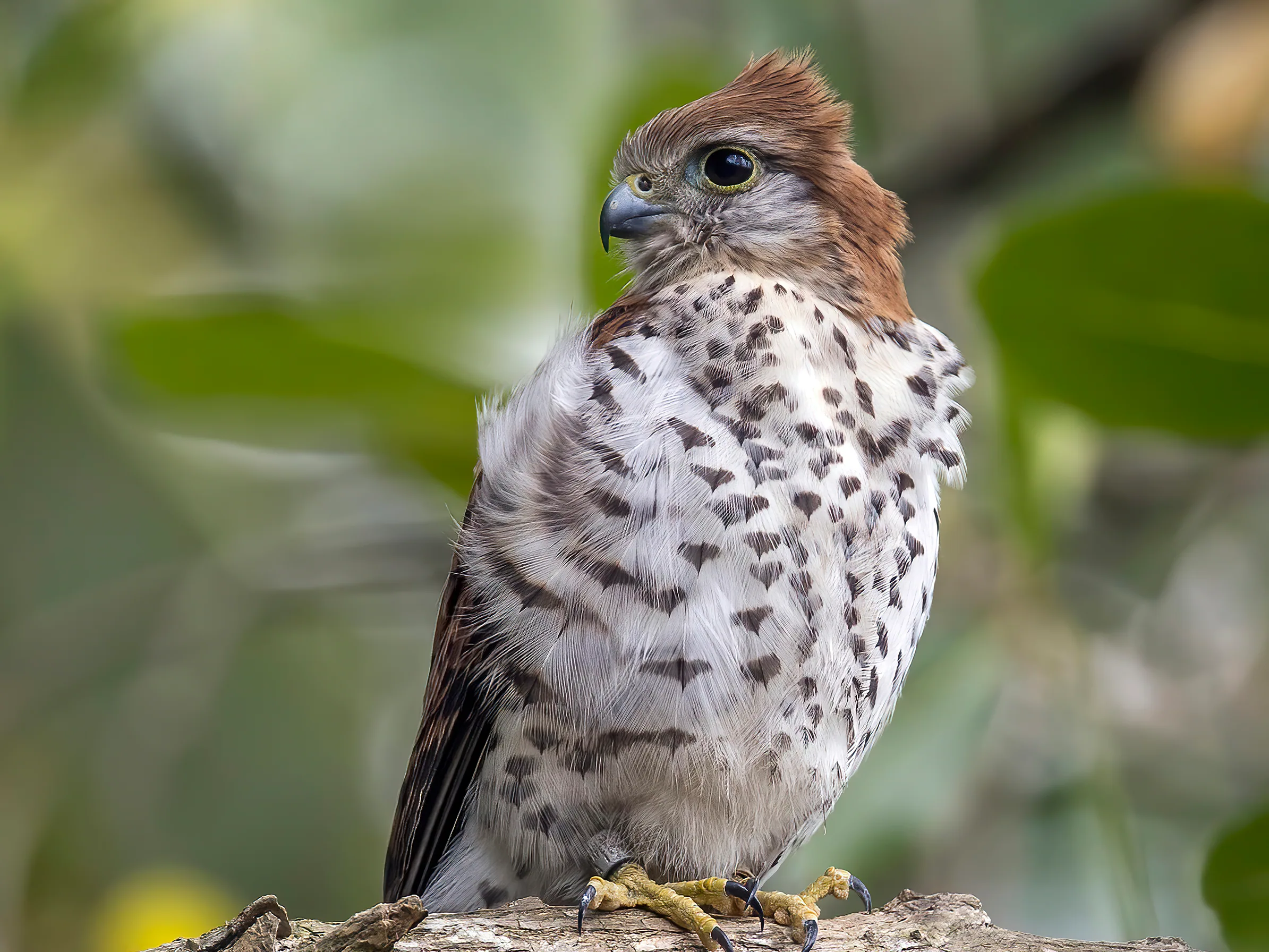
Which Mauritius endemic birds live around Chamarel?
All eight Mauritius endemic birds live in the Black River Gorges National Park above Chamarel. They are the Mauritius kestrel, the pink pigeon, the echo parakeet (also called the Mauritius parakeet), the Mauritius cuckooshrike, the Mauritius bulbul, the Mauritius olive white-eye, the Mauritius grey white-eye and the Mauritius fody.
The park protects most of the remaining rainforest in Mauritius, and the area around Chamarel and Le Morne is a Key Biodiversity Area of about 29 km² of subtropical moist forest, from 20 to 611 m. Three birds qualify it, the Mauritius kestrel, listed as Endangered, and the pink pigeon and the echo parakeet, both listed as Vulnerable. The table shows where each species is most likely near Chamarel, and none of them can be promised on a visit.
| Species | Numbers or status | Where to look near Chamarel |
|---|---|---|
| Mauritius kestrel | 4 known wild birds in 1974, over 300 today | Western population in and around the national park, one or two breeding pairs at Ebony Forest |
| Pink pigeon | About a dozen known birds in the 1990s, over 400 today | Main population in and around the national park, 50 juveniles released at Ebony Forest in 2018 and 2019 |
| Echo parakeet | An estimated 20 in the 1990s, about 800 today | Native population in and around the national park, 46 young birds released at Ebony Forest since 2021 |
| Mauritius grey white-eye and Mauritius bulbul | Endemic | In the national park and on Ebony Forest’s bird-watching list |
| Mauritius olive white-eye | Endemic | In the national park, with no reliable spot to recommend |
| Mauritius cuckooshrike and Mauritius fody | Endemic | In the national park, with no reliable spot to recommend |
| Mauritian flying fox | Endangered after government culls | Mostly the Bel Ombre forest, also the national park, active at dusk and dawn |
The Mauritius kestrel, from four birds to more than 300
The Mauritius kestrel is a falcon found only on Mauritius. It fell to 4 known birds in the wild in 1974 and has recovered to more than 300 by Ebony Forest’s count.
Its numbers fell through the 19th century, and DDT used in the 1950s brought it close to extinction. Recovery work by the Mauritian Wildlife Foundation and the National Parks and Conservation Service rebuilt the population, which now lives in two groups, a western one in and around the Black River Gorges National Park and an eastern one in the Bambou mountains.
Around Chamarel, the Mauritian Wildlife Foundation put up nest boxes at Ebony Forest between 2012 and 2014, but no pair used them until 2019. Since then one or two breeding pairs have bred there regularly, Chamarel sits within the kestrel’s range, and Ebony Forest’s bird-watching tour names the kestrel among the birds to look for. The forest around Chamarel is a reasonable place to look, and nobody can promise a sighting.
Where can you see pink pigeons and echo parakeets in Mauritius?
Pink pigeons and echo parakeets live mainly in and around the Black River Gorges National Park, where their main wild populations are, and at Ebony Forest in Chamarel, where both have been released.
The pink pigeon was down to about a dozen known birds in the 1990s, in a small cryptomeria wood near Piton Savanne, and now numbers over 400. Besides the main population there are introduced groups on Île aux Aigrettes, in the Bambou range and at Ebony Forest, where the Mauritian Wildlife Foundation released 50 juveniles from the Black River Gorges in 2018 and 2019. A pink pigeon release site also lies behind the Pétrin information centre.
The echo parakeet fell to an estimated 20 birds in the 1990s and now numbers about 800. A first attempt to settle it at Ebony Forest in 2018 and 2019 failed because none of the birds stayed, so since 2021 the Ebony Forest team has hand-reared young parakeets and released 46 of them. Rats and macaques prey on both species, and both are on Ebony Forest’s bird-watching list.
How Ebony Forest is bringing the native forest back
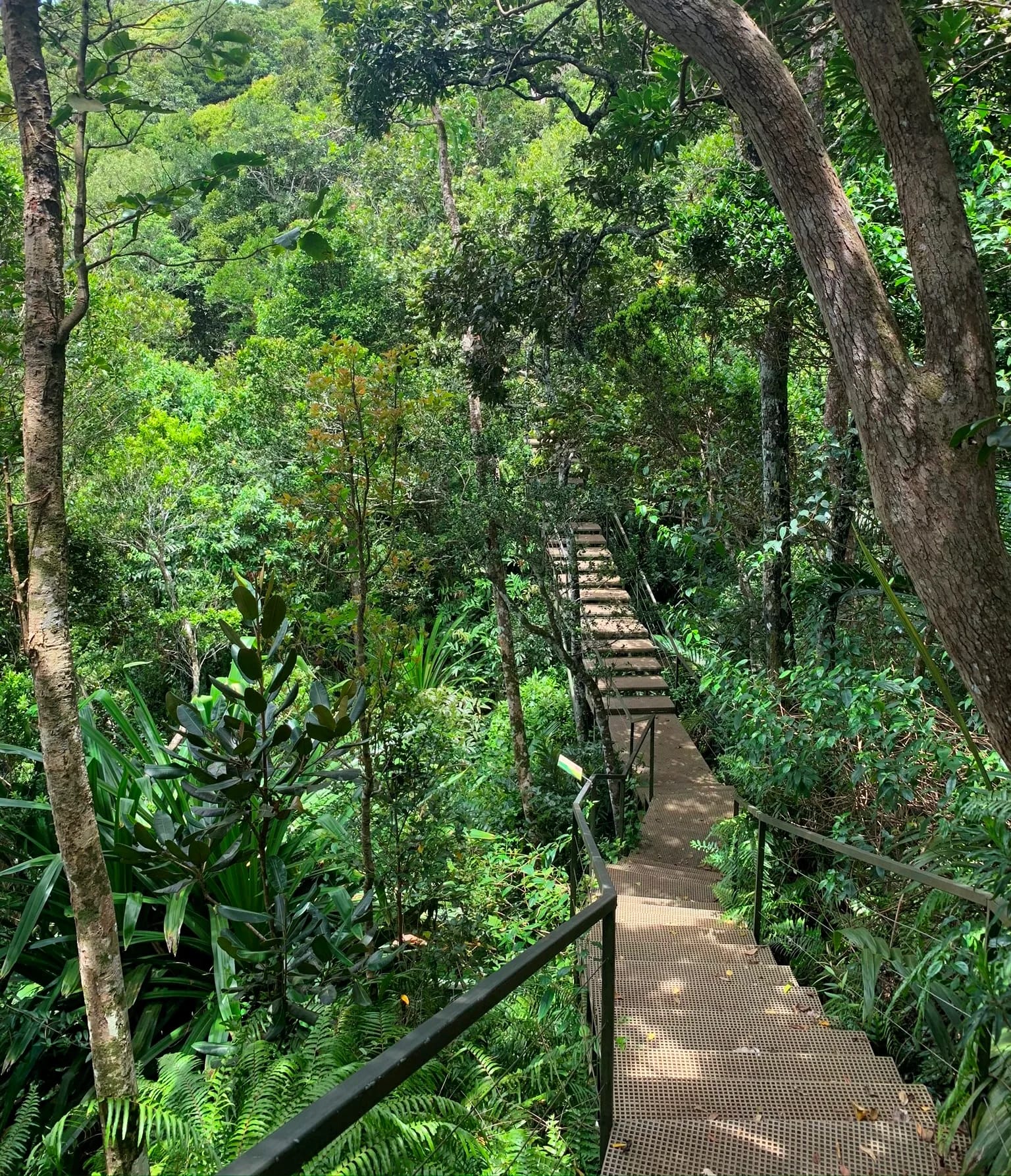
Ebony Forest, a registered non-profit reserve at Chamarel, has been clearing invasive plants and replanting native forest since 2006 and now manages three forests covering 195 ha.
By its own count the reserve has planted more than 200,000 endemic and native plants, weeded and replanted more than 50 ha of endemic forest, propagated 118 species, reintroduced four endemic bird species and started two tortoise rewilding projects, and it runs two predator-control grids totalling 90 ha, one of 50 ha at Ebony Forest and one of 40 ha at Vallée de l’Est. The reserve, founded by Owen and Mary-Ann Griffiths, opened its visitor centre to the public in 2017. UN Tourism’s village profile gives a founding in 2017 on 34 ha and over 154,000 native plants; the figures used here are the reserve’s own.
The Chamarel 7 Coloured Earth Geopark has also worked with the Mauritian Wildlife Foundation since 2009 on removing invasive plants and planting natives, and has supported echo parakeet and pink pigeon work. At Ebony Forest, you see the restored forest from a raised walkway about 300 m long and more than 4 m high on the way to Sublime Point.
Invasive plants and animals in the forest
Much of the native forest around Chamarel has been degraded by introduced species, plants such as Chinese guava and privet, and animals such as rusa deer and wild pigs.
Ebony Forest’s weeding list adds hiptage, tabebuia, ravenala, jambos and litsea to the Chinese guava, and its list of introduced mammals runs to pigs, deer, rats, cats, mongooses, macaques and tenrecs. Some of these end up on local menus. The Rhumerie de Chamarel’s restaurant, L’Alchimiste, serves venison and wild boar, and village tables d’hôtes serve game.
Chinese guava is the invasive plant most visitors notice, because its fruit is picked along the Plaine Champagne road from about mid-April to mid-May, when parked cars line the road.
Monkeys in Mauritius, and how to behave around them
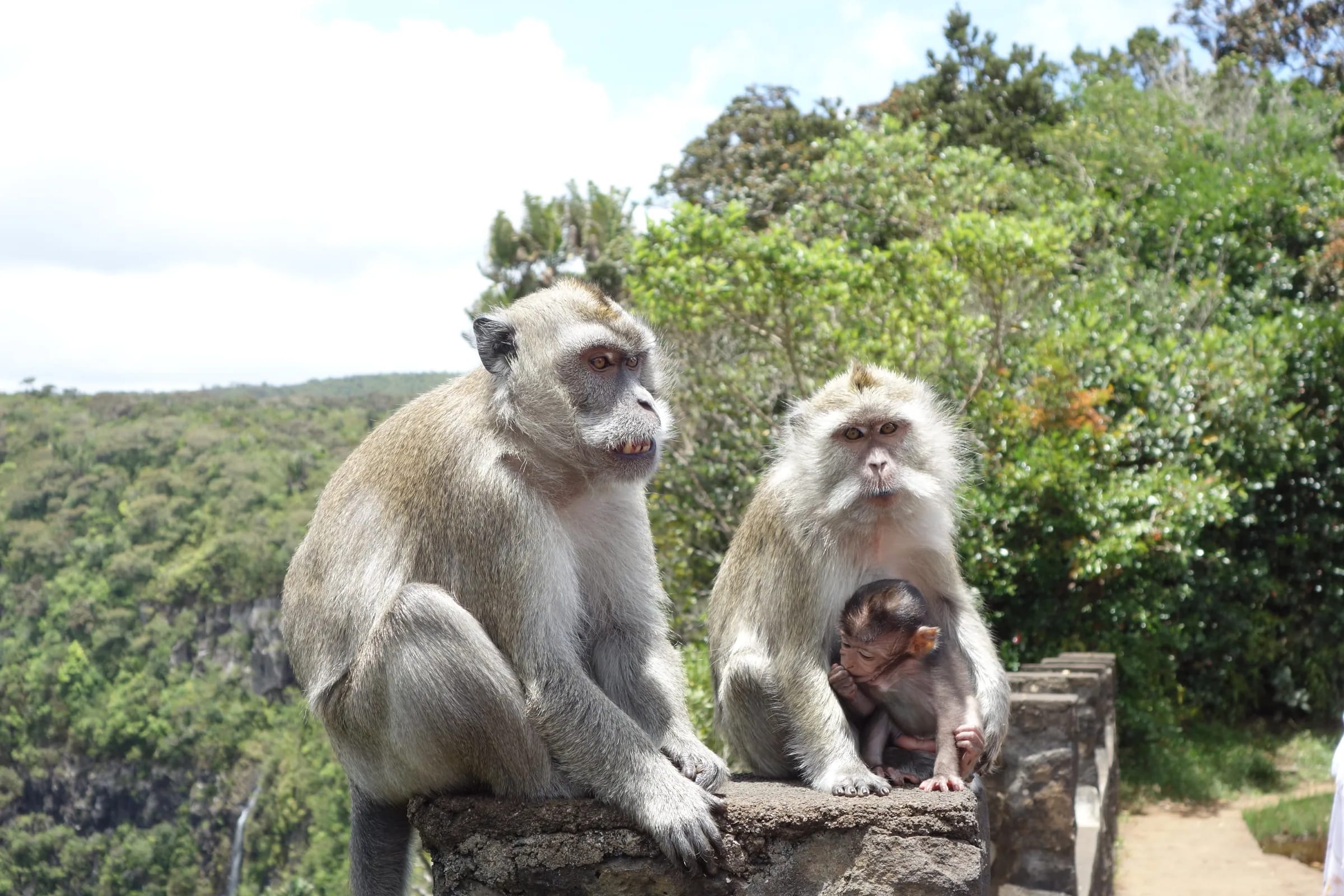
The monkeys you see around Chamarel are long-tailed macaques, an introduced species that gathers at the plateau viewpoints and takes food from people.
Ebony Forest counts macaques among the introduced mammals in its forests and among the predators of the pink pigeon and the echo parakeet. You meet them at the Gorges viewpoint car park and railing, where they approach in silence, at the Alexandra Falls car park, where signs prohibit feeding, and on the Black River Peak path.
- Do not feed them, even from a car window. Feeding is prohibited at Alexandra Falls.
- Keep food sealed and out of sight, and do not eat in front of a group.
- Close car windows and doors before you walk away, and keep bags zipped.
- If a macaque grabs something, let it go rather than pulling back, and keep children close.
- Give them room on paths and at the railing, and walk on calmly.
Where and when to look for wildlife near Chamarel
Ebony Forest’s morning bird-watching tour is the organised way to look for endemic birds near Chamarel, and the Mauritian flying fox is most active at dusk and dawn.
The guided bird-watching tour starts at 09:00, the best hour for sightings, and lasts 3 to 4 hours over 4.8 km. The birds to look for are the pink pigeon, the echo parakeet, the Mauritius kestrel, the Mauritius black bulbul, the grey white-eye and a native flycatcher. The tour costs Rs 2,500 for non-resident adults and Rs 1,650 for ages 5 to 17, or Rs 2,000 and Rs 1,200 for residents, with a minimum of two adults and advance booking required (checked on 29 October 2026). No tour guarantees every species, and Ebony Forest does not pretend otherwise.
The Mauritian flying fox, the largest endemic mammal in Mauritius, feeds on fruit and nectar and mostly roosts in the Bel Ombre forest, with smaller groups in Combo Forest and at Black River village, and it also lives in the national park. The species is listed as Endangered after government culls meant to protect fruit crops, including one of 20,000 bats approved by Parliament in October 2015 and another announced in October 2018.
Questions people ask
What endemic birds live in Mauritius?
The endemic birds of Mauritius are the Mauritius kestrel, the pink pigeon, the echo parakeet, the Mauritius cuckooshrike, the Mauritius bulbul, the Mauritius olive white-eye, the Mauritius grey white-eye and the Mauritius fody. All eight live in the Black River Gorges National Park above Chamarel, and the kestrel, the pink pigeon and the echo parakeet have recovered from 20 birds or fewer after decades of conservation work.
Where can I see a Mauritius kestrel?
The Mauritius kestrel’s western population lives in and around the Black River Gorges National Park, and one or two pairs have bred at Ebony Forest in Chamarel since 2019. Ebony Forest’s bird-watching tour, which starts at 09:00 (checked on 29 October 2026), names the kestrel among the birds to look for, and no tour can guarantee a sighting. The species has recovered from 4 known wild birds in 1974 to more than 300.
Are there monkeys in Mauritius?
Yes, Mauritius has long-tailed macaques, an introduced species. Around Chamarel they gather at the Black River Gorges viewpoint and Alexandra Falls car parks and on the Black River Peak path, and they take food from bags and cars. Do not feed them, which is prohibited at Alexandra Falls, keep food sealed and out of sight, and keep car windows closed when you walk away.
Where can you see pink pigeons in Mauritius?
Pink pigeons live mainly in and around the Black River Gorges National Park, with introduced groups on Île aux Aigrettes, in the Bambou range and at Ebony Forest in Chamarel, where 50 juveniles were released in 2018 and 2019. Ebony Forest’s bird-watching tour names the pink pigeon among its target species. The population has grown from about a dozen known birds in the 1990s to over 400.
What is the Mauritian flying fox?
The Mauritian flying fox is a large bat that feeds on fruit and nectar and is the largest endemic mammal in Mauritius. It lives in the forests of the Black River Gorges, Bel Ombre and Combo, is mostly active at dusk and dawn, and is listed as Endangered after government culls in 2015 and 2018 that were meant to protect fruit crops.
Why are there deer and wild pigs in the Mauritian forest?
Rusa deer and wild pigs are introduced animals that now degrade the native forest of the Black River Gorges National Park, together with invasive plants such as Chinese guava and privet. Ebony Forest also counts rats, cats, mongooses, macaques and tenrecs among the introduced mammals in its forests. Venison and wild boar appear on local menus, including at the Rhumerie de Chamarel’s restaurant.
Can you see endemic birds at Ebony Forest?
Yes. Ebony Forest in Chamarel has released pink pigeons and echo parakeets and has breeding kestrels, and its guided bird-watching tour at 09:00 names six birds to look for. The tour costs Rs 2,500 for non-resident adults and Rs 2,000 for resident adults (checked on 29 October 2026) and needs advance booking. No tour can guarantee that you will see every species.
Visit the restored forest
The Ebony Forest page covers tickets, the raised walkway, Sublime Point and the self-guided trails at Chamarel.