
Grand Bassin in Mauritius, the sacred crater lake of Ganga Talao
Grand Bassin in Mauritius, also called Ganga Talao, is a sacred Hindu crater lake about 550 m above sea level in Savanne district, free to visit, with a 33 m statue of Shiva at its gateway and temples around its shore. From Chamarel it is 16.8 km and about 16 minutes by road across the Plaine Champagne plateau. Several hundred thousand pilgrims walk to the lake for Maha Shivaratri each February or March, so those are the days to plan around.
Read the guide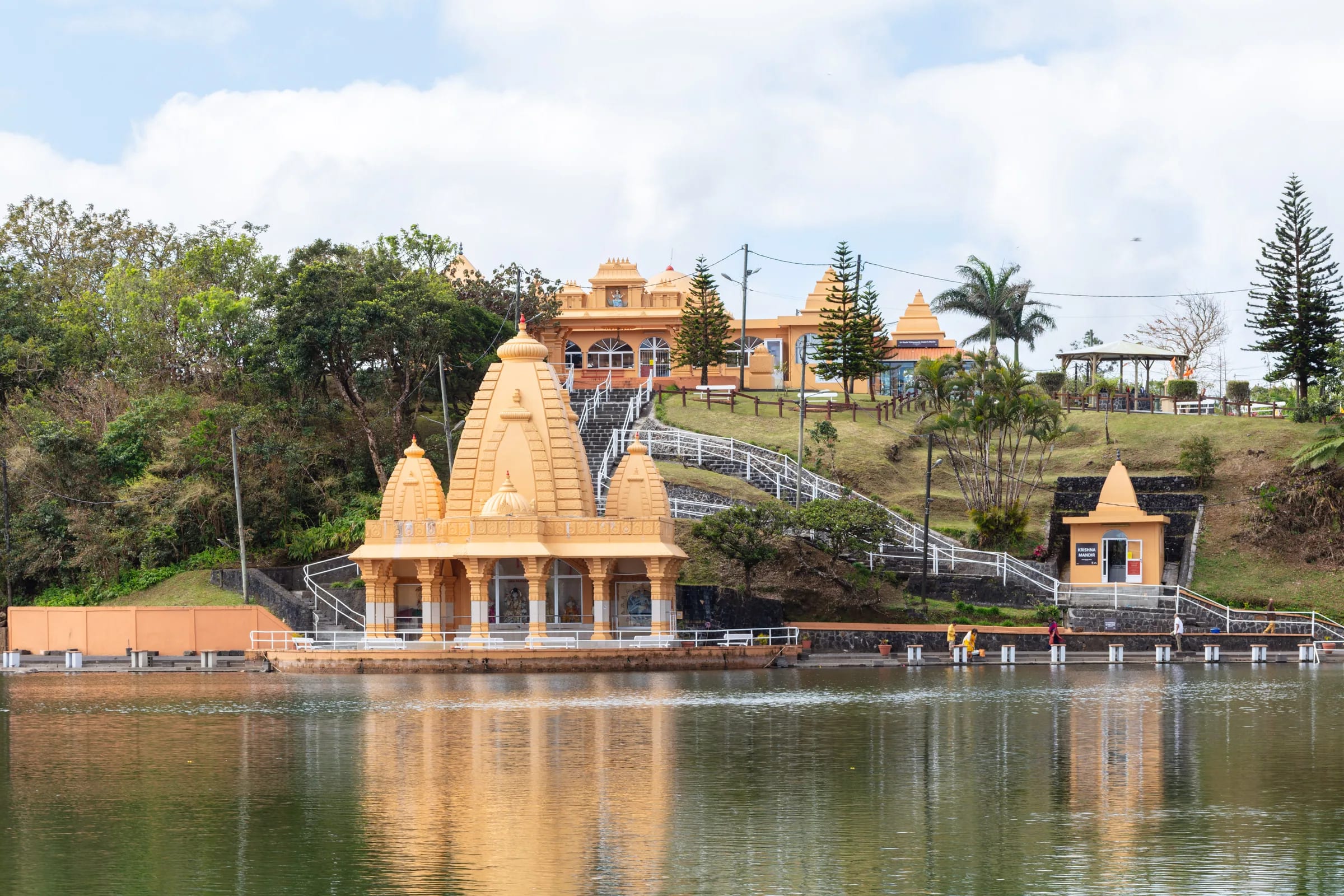
Grand Bassin in Mauritius is a crater lake that Hindus call Ganga Talao
Grand Bassin is a lake in a volcanic crater about 550 m above sea level in the Savanne district of Mauritius, at 20°25′05″S 57°29′31″E. Mauritian Hindus know it as Ganga Talao, the lake of the Ganges, and it is an important Hindu site, high in the uplands of Savanne.
The lake took the name Ganga Talao in 1972, when water from the Ganges was mixed into it, and it was declared a sacred lake in 1998. Before 1972 it was known as Pari Talao, after a folk tale of fairies dancing on the water at night.
Grand Bassin is not in Chamarel. The lake lies on the far side of the Plaine Champagne plateau, just beyond the Pétrin end of the Black River Gorges National Park, so it is the natural end of a drive along the plateau road rather than a separate day out.
The Grand Bassin temples and the two 33 m statues
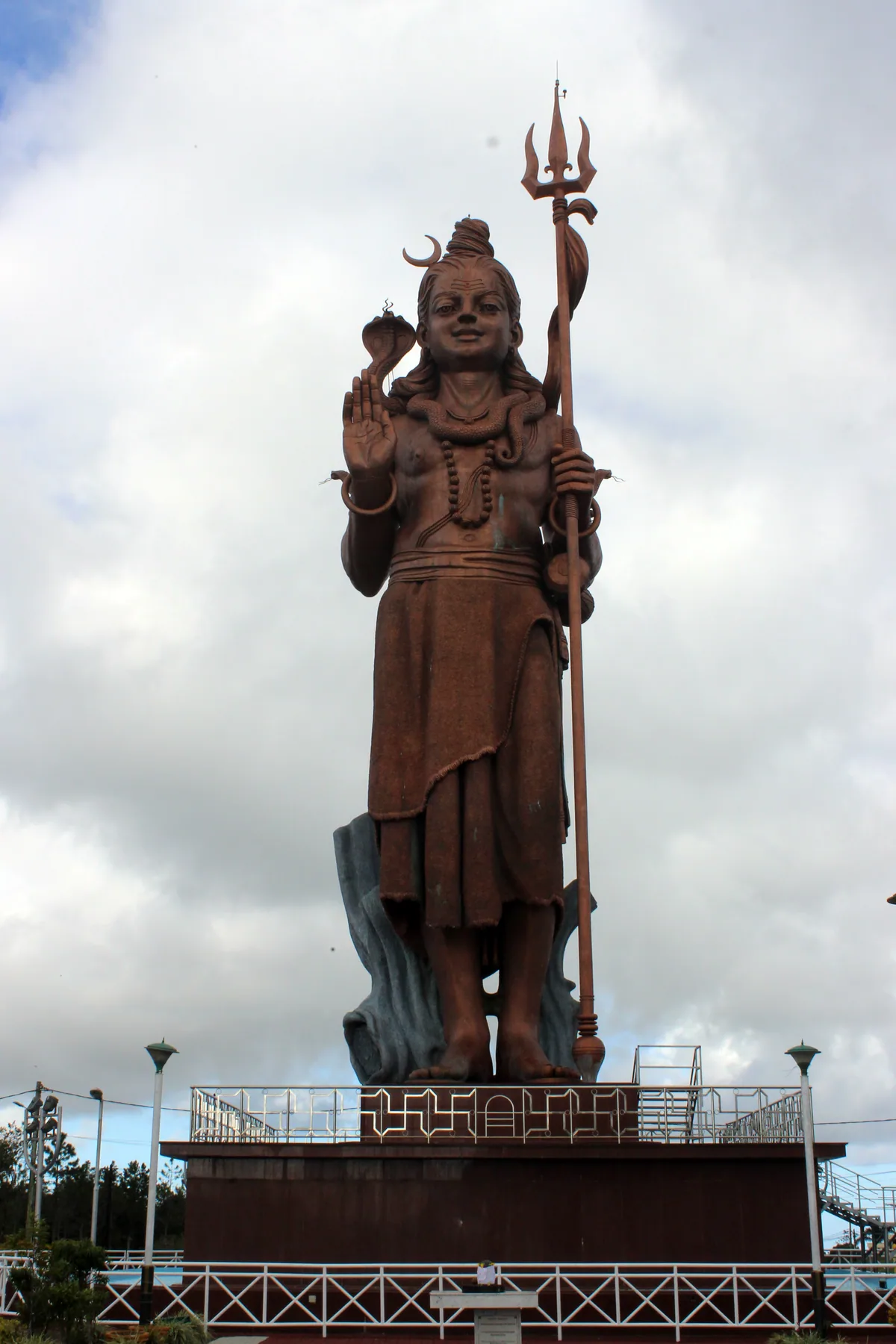
The temples and shrines of Grand Bassin stand around the shore of Ganga Talao, and two statues 33 m tall, Shiva as Mangal Mahadev and the goddess Durga, rise on either side of the main road in from the east.
Mangal Mahadev shows Shiva standing with his trident at the entrance to Ganga Talao. The statue is 33 m (108 ft) tall, the tallest statue in Mauritius, and was inaugurated in 2007 as a faithful copy of the Shiva statue at Sursagar Lake in Vadodara, Gujarat. The statue of Durga, Durga Mata Murti, stands to the same height of 33 m. The year it went up is not published.
Around the water stand temples to Hanuman, the goddess Ganga and Ganesh, 11 temples and shrines in all. Take your time on the shoreline, past the colourful shrines along the lake’s edge. Pilgrims pray with the lake water, and many bottle some of it.
How the pilgrimage began, and why the dates differ
The pilgrimage to Grand Bassin is usually traced to a dream in 1887 and a first group of pilgrims in 1898, but the Mauritian accounts give different dates.
In the usual account, Pandit Jhummun Giri of Triolet dreamed in 1887, or in the 1890s by some tellings, that he saw the waters of Ganga Talao, and the first group of pilgrims set out from Triolet in 1898, led by Pandit Giri Gossayne from Terre Rouge. A second account links the start of the pilgrimage to a consecration in 1866 and makes Jhummun Giri the first pilgrim to carry a kanwar from Triolet to Grand Bassin, in 1897.
The two versions agree on the later milestone. In 1972 water from the Ganges, brought from Gomukh in India, was mixed into the lake, and the lake was renamed Ganga Talao. No primary record settles the date of the first pilgrimage, so both dates stand.
Maha Shivaratri brings the biggest crowds of the year
Maha Shivaratri, the most important Hindu festival in Mauritius, brings several hundred thousand pilgrims to Grand Bassin each year, many of them walking from home in the days before the festival night.
Estimates run from about 350,000 devotees, the figure given for the festival on 15 February 2026, to close to half a million. Dressed in white, pilgrims set out from every corner of Mauritius and converge on the Savanne uplands, many carrying kanwars, small hand-made shrines dedicated to Shiva, while volunteers put up tents along the way to offer them water, food and rest.
Maha Shivaratri follows the Hindu lunar calendar and usually falls in February or March. The next one in Mauritius is listed for Saturday 6 March 2027. Check the official public-holiday list nearer the time before you plan around it.
The festival is the time to come if you want to see the celebrations in full swing. Go as a respectful observer and leave the space at the water’s edge to the pilgrims.
How to avoid the pilgrimage traffic
The simplest way to avoid the pilgrimage traffic is to keep Grand Bassin and the plateau roads out of your plans in the days before Maha Shivaratri, unless the festival is the reason you are going.
In 2026 the busiest areas were La Marie, Plaine Sophie, Pétrin and the approaches to Grand Bassin, where the authorities concentrated their security and traffic arrangements. Pétrin matters for anyone coming from Chamarel, because the road from Chamarel passes through the Pétrin area before the B88 takes it on to the lake.
Hold-ups can also happen well away from the lake. On the evening of Thursday 12 February 2026, after police stopped kanwars that broke the size rules, groups of pilgrims blocked both lanes of the road between Highlands and Curepipe and traffic came to a temporary standstill.
- Visit Grand Bassin on an ordinary day outside the festival period, when the lake is a place of peace and quiet.
- If you have to drive the plateau in the days before the festival, go slowly and give walking pilgrims plenty of room, especially after dark.
- No bus route is published between Chamarel and Grand Bassin, so the trip needs a car or a taxi at any time of year.
How to dress and behave at Grand Bassin
Grand Bassin is a place of worship first. Take your shoes off before entering a temple and cover your shoulders and knees.
Shoes always come off before the inner areas of any temple. Covered shoulders and knees are a mark of respect rather than an enforced rule, and nobody checks, but dress that way anyway. All the temples are open to everyone at no charge, and you do not need to be Hindu to go in.
Pilgrims come to Ganga Talao to worship, light incense, pray and make offerings, so keep your voice down near the shrines, give people room at the water and leave offerings where they are.
Monkeys live around Grand Bassin and play along the shore. They are wild long-tailed macaques, the same animals that raid bags at the Black River Gorges viewpoint on the drive from Chamarel, so keep food out of sight, keep bags closed and do not feed them.
The drive from Chamarel over the plateau
Grand Bassin is 16.8 km from Chamarel by road, about 16 minutes without stops, east along the B103 Plaine Champagne Road and then the B88 Grand Bassin Road. Some figures put the distance nearer 20 km. Cloud builds over the plateau as the day warms, so allow longer than 16 minutes and go early.
Up from Chamarel
Leave the village, at about 260 m, on the B103 Plaine Champagne Road. The road tops out at about 740 m, and the plateau is markedly cooler than the coast, so bring a layer.
The Gorges viewpoint
About 4 km east of the village in a straight line, the Black River Gorges viewpoint has a large free car park beside the road and a gentle path of about 200 m to the lookout. The macaques here raid bags.
Alexandra Falls
Further east, a signposted turning off the Plaine Champagne road leads to the Alexandra Falls viewpoint, about 700 m above sea level, with a car park and a wooden platform.
Pétrin and the B88
At the Pétrin end of the plateau the road meets the B102, and the B88 Grand Bassin Road runs the last stretch to the lake. In the days before Maha Shivaratri, the Pétrin area is one of the busiest on the pilgrims’ routes.
At the lake
There is a car park beside Ganga Talao, and the Shiva statue stands at the gateway to the lake. Leave your shoes at the temple doors and walk the shore at your own pace.
Questions people ask
Is Grand Bassin free to visit?
Grand Bassin is free to visit, and all the temples are open to everyone at no charge, whether or not they are Hindu. No official opening hours are published for the lake. The time to think twice is the run-up to Maha Shivaratri, when several hundred thousand pilgrims converge on Ganga Talao and the roads around Pétrin and La Marie are crowded.
How far is Grand Bassin from Chamarel?
Grand Bassin is 16.8 km from Chamarel by road, about 16 minutes without stops, along the B103 Plaine Champagne Road and the B88, or nearer 20 km by another measure. The route crosses the plateau past the Black River Gorges viewpoint and Alexandra Falls, so it is easy to stop on the way, and no bus route is published between the two.
How tall is the Shiva statue at Grand Bassin?
The Mangal Mahadev statue of Shiva at Grand Bassin is 33 m (108 ft) tall, the tallest statue in Mauritius. Inaugurated in 2007, it copies the Shiva statue at Sursagar Lake in Vadodara, India. The statue of the goddess Durga stands to the same height of 33 m, and the two stand on either side of the main road in from the east.
When is Maha Shivaratri in 2027?
Maha Shivaratri follows the Hindu lunar calendar. In Mauritius it is listed for Saturday 6 March 2027, after Sunday 15 February in 2026. Check the official public-holiday list nearer the time. Pilgrims start walking to Grand Bassin a few days before the festival, so the roads around Pétrin, La Marie and Plaine Sophie are busy well ahead of the date itself.
What should I wear to visit Grand Bassin?
Take your shoes off before entering any temple at Grand Bassin, and cover your shoulders and knees as a mark of respect. Nobody checks, but dress that way anyway. Shoes that slip off easily help. Bring a layer as well, because the drive across the Plaine Champagne plateau is markedly cooler than the coast.
Are there monkeys at Grand Bassin?
Monkeys are a regular sight at Grand Bassin, playing along the shore. They are wild long-tailed macaques, the same animals that raid bags at the Black River Gorges viewpoint on the drive from Chamarel. Keep food out of sight, keep bags closed and do not feed them.
Why is Grand Bassin called Ganga Talao?
Grand Bassin is called Ganga Talao, the lake of the Ganges, because water from the Ganges was mixed into the lake in 1972 and the lake was renamed. Before that it was known as Pari Talao, after a folk tale of fairies dancing on the water at night. Ganga Talao was declared a sacred lake in 1998.
Drive the plateau road stop by stop
The Plaine Champagne road page covers every viewpoint between Chamarel and Grand Bassin, and the fog the road is known for.